
Blog Publish Workflow Refinement with Claude
This workflow describes the process of transferring (formatting, final edits, internal/external linking, identifying key highlights, and scheduling for release the final draft of the blog post) from Google Drive (the writing platform) to WordPress (the publishing platform).
🎯 The goal of this blog's publish workflow refinement is three-fold:
💡 Why Do I Choose to Revamp the Blog Publish Workflow?
💡 Why Claude AI?
Step 1: Current Process Evaluation with Claude
Step 1 was conducted on Friday, May 15, 2026.
💬
⌛
💬
⌛
Conclusion of Step 1: What I Learned
🧠
Step 2: Human Review of Claude Artifacts + Final Refinements Before Deployment
Step 2 was conducted on Friday, May 15, 2026.
🛑 AI responses have a tendency to hallucinate, which means they will produce responses that sound like accurate answers but are made-up. That’s where I would have to review the Claude artifacts to ensure their accuracy for my use case. A step that is great to satisfy the second goal of this workflow refinement revamp
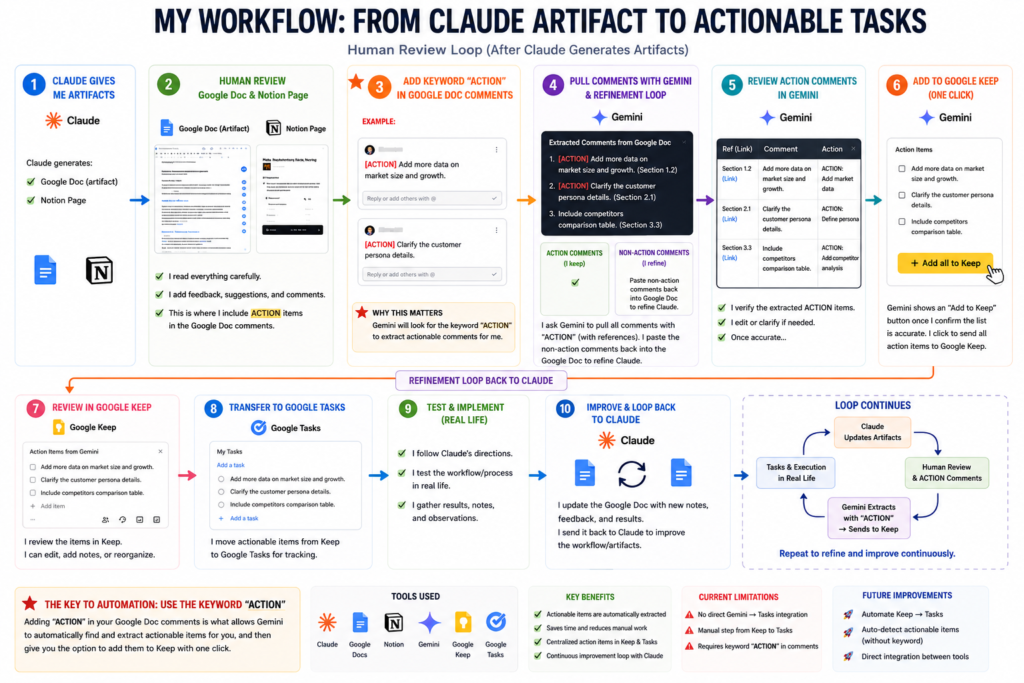
Step 3: Incorporating the “Next Steps” of a Previous Workflow Revamp
This step requires the testing of a previous workflow revamp, which was completed on Tuesday, May 26, 2026.
I am incorporating Claude into two workflow revamps simultaneously: blog publishing (this workflow revamp) and newsletter idea curation + publishing (another workflow revamp). Currently, my newsletter creation + publishing schedule and my blog publishing schedule are on an alternating weekly basis. As Step 2 of this blog publishing revamp comes right after a blog upload and in closer alignment with the newsletter schedule (week of May 18th), the workflow testing of the newsletter idea curation + publishing was done first.
This arrangement resolves several operational concerns:
- Reduce Operational Redundancy and Conflicts: By aligning the revamp test with its respective publishing schedule, I was able to get two deliverables while doing the test. A newsletter that’s published on schedule, and this case study.
- This approach ensures that the experimentation required for this case study will have the least impact/conflict on the deadlines for more established deliverables (blogs/newsletters).
- There is no need to wait until the week of May 25th (the next blog publish schedule) to start the workflow revamp. Proxy-based information could be gathered via another similar workflow revamp to anticipate friction, apprehend results, and increase the probability of succeeding the “under an hour” goal when the next blog publish schedule rolls around.
- Enriched Case-Study and Process Improvement by Building from the Previous: Since the approach and level of Claude-generated revamps for both workflows are about the same, redundant results, and the lack of new findings could be resolved by feeding in post-process recommendations in the newsletter revamp test to improve the overall workflow revamp process and audience interest of this case study.
👉
Step 4: Real-Life Workflow Testing
Sub-Step 1: Task-Mining Tools Research & Preparation
This sub-step was conducted on Wednesday, May 26, 2026.
🎯 The long-term goal of incorporating task mining into the overall content management system is to remove a major friction point: having to document each workflow by memory and relying on my sole ability to explain the workflow steps in detail as the single point of truth and context for Claude to refine/suggest future iterative refinements.
🎯 The purpose of this research/preparation substep isn’t to incorporate a fully operable task-mining workflow.
Sub-Step 2: Testing Claude-Suggested Blog Publish Workflow
This sub-step was conducted on Thursday, May 27, 2026.
💬
💬
Conclusion of Step 4 (Part 1): Next Step Approach
✅
💬
💬
✅
💬
💬
✅
✅
✅