- The Goals of this Workflow Revamp
- Why Do I Choose to Revamp the Newsletter Curation/Publish Workflow?
- Why Claude AI?
- Step 1: Current Process Evaluation with Claude
- Step 2: Human Review of Claude Artifacts + Final Refinements Before Deployment
- Why is human review necessary?
- The Human Review Process
- Step 2: Real-Life Workflow Testing
- Step 4: Calculating Results
- Step 5: Next Steps – Using the 3 Nivationist Principles
This workflow illustrates the newsletter creation process. The workflow involves MailerLite (the newsletter editor/sender), Notion (the Claude-generated single-truth idea-curation library), and Google Keep (the fast idea-jotting app).
Components of the newsletter include recent posts, upcoming posts previews/highlights, Nivationist announcements, and 2-3 call-to-action inspirational ideas to help Nivationist’s subscribers take action towards their own endeavors.
It’s the first iteration of integrating AI to optimize workflow and reduce content production time from a previously manual workflow.
The Goals of this Workflow Revamp
The goal of this blog’s publish workflow refinement is three-fold:
Workflow Refinement (Primary): Reduce writer’s block and perfectionism (the bottleneck that leads to 3+ hours from newsletter creation to “schedule-ready”) to limit the workflow completion time to under an hour.
Anticipate the Effectiveness for Another Workflow: Claude offered a similar refinement approach to two workflow components: blog publishing & newsletter curation/publishing (this case study). Since the timing of the test aligns more closely with the newsletter creation, the results of the newsletter revamp test will be a great predictor of the effectiveness of the blog publishing workflow.
Mental Offloading for Business Growth: Make space to begin social media marketing initiatives to increase subscriber count and generate testimonial/case study material through freelance work.
Why Do I Choose to Revamp the Newsletter Curation/Publish Workflow?
- Immediate Impact —> One of the biggest bottlenecks right now, and it is easy to validate the level of satisfaction.
- Clear Distinction Between Human-Controlled vs. AI-Assisted —>
- The content (personal reflections, raw notes, experiences, skills, decision-making, etc.) is free from AI, which retains ownership, integrity, and ownership to my audience, brand, and myself.
- The presentation (do the words fully reflect what I wish to articulate, ways to better help my audience, etc.) is a collaborative effort with AI.
- Operational processes (such as repetitive formatting, transfer of information, element checklists, etc.) could be laid out to be fully automated in the future.
- Semi-Established Consistency of Habit —> The newsletter publishing workflow is well established, but the methods of content curation are scattered without a central referenceable hub.
Why Claude AI?
- Teachable Tool with Structured Organization: I can teach Claude skills by providing process instructions in plain language, written as AI prompts that are easily retrievable and editable, to ensure my responses are consistent and more predictable.
- Thought Leaders Advocated: Ali Abdaal, one of the most influential self-help influencers, mentioned Claude as a key contributor to the upscaling of his business’s creative operations.
- Tool Scalability:
- All-in-one work hub with native connectors to existing management tools I already use for seamless API integration with intuitive ways to scale as business operations grow.
- Business-friendly features such as data visualization, document artifacts, and custom dashboards (future expansion into Claude Code and Claude CoWork).
- Audience Interest & Searchability: Claude AI is a trendy topic with high amounts of search volume.
Step 1: Current Process Evaluation with Claude
Step 1 was conducted on Friday, May 15, 2026.
Claude’s Response + Deliverables
Claude was given the context that this newsletter curation + publish workflow is a part of a bigger content management system.
The newsletter curation/publish workflow (this case study) and the blog publish workflow
were both targeted to be revamped with a similar level of approach.
For more information about the AI prompts I used and the prompt findings I’ve discovered during the process, see the blog publish workflow case study.
- 1 Google Docs artifact on the step-by-step instructions on how to implement and use the workflow with tailored AI prompts.
- Generated the [Public] Newsletter Content Bank on Notion as a fillable template to jot down weekly reflections, insights, third-party inspirations, etc., that could be used to populate and refine for the next newsletter.
Step 2: Human Review of Claude Artifacts + Final Refinements Before Deployment
Step 2 was conducted on Friday, May 15, 2026.
Why is human review necessary?
AI responses have a tendency to hallucinate, which means they will produce responses that sound like accurate answers but are made up. That’s where I would have to review the Claude artifacts to ensure their accuracy and intuitiveness of use for my use case.
This step is great for testing the synergy between Claude and other built-in AIs within my existing blog management tools (i.e., Google Drive —> Gemini, Notion—> Notion AI, Elementor —> Elementor AI)
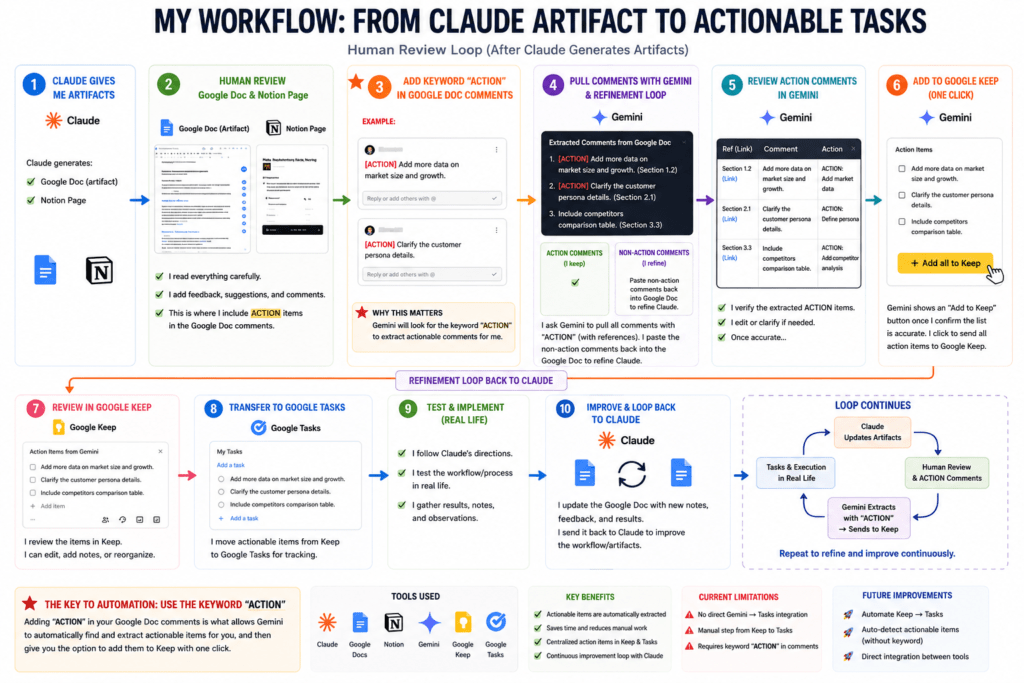
The Human Review Process
The human review workflow diagram below was made by
- audio transcribing the process (via Google Keep) of how I conduct the human review process, and then
- generated via ChatGPT.
Switch Google Tasks with Todoist: Instead of using Google Keep (the default task execution tool when using Gemini), it’s better to route it to Todoist (the task execution tool I’m currently using).
[Action]: Research the best method to transport the extracted “Actions” tasks straight into Todoist from Gemini.
Step 2: Real-Life Workflow Testing
Step 3 was conducted on Wednesday, May 20, 2026.
A newsletter is due this week, which is a great opportunity to test the recommended workflow revamp in real-time.
Part 1: Claude AI Content Curation + MailerLite Email Setup
Part 1 Workflow Description
Claude splits the newsletter curation + publishing workflow into two parts. Part 1 consists of the following main deliverables:
- Selecting 1-3 rotating prompts to write about in the newsletter
- Writing a short description for each selected rotating prompt
- Compiling and uploading context files
- Let Claude generate a post description of the recent blog, 1-3 insights pulled straight from the next upcoming post, and further elaborate on rotating prompt responses based on my brand voice from my blog and past newsletters (uploaded as context files).
- Let Claude generate a list of email subject lines and preheader descriptions to use during the human revision/review process.
[In-Process Friction Points / Solutions] Part 1: Idea Curation, MailerLite Email Setup
Previous Workflow Time: ~2 hours
Claude’s Target Time: 10 minutes
Current Workflow Time (Actual): 25 minutes
- I have to update the [Public] Newsletter Content Bank, which is a single-truth hub for all notes, reflections, experiences, insights, etc., for newsletter content curation on the day of the workflow test.
- Writer’s block: Having to think back to what happened this week. It takes me 13 minutes to write three raw inputs, one for each newsletter topic category.
- [Quick-Fix Solution] New Habit Developed: I started jotting down ideas and reflections via audio and text on Google Keep, reducing this friction in the future.
- Manually searching and pasting the context needed for each Claude AI prompt.
- Claude’s workflow refinement instructions present each step as a standalone prompt with no cross-referencing. Claude doesn’t recommend its own time-saving features, such as using Projects and/or Skills. This led to context redundancy.
- [Quick-Fix Solution]: In-the-Moment Initiative: Instead of repeatedly copying/pasting the same file as instructed, I uploaded all the files needed for each prompt by consistently using the referencing shorthand (ref: “file name”) immediately after the context. I jot down each reference file name on paper for quick/consistent referencing for subsequent prompts and to prevent redundant uploads.
- Claude AI became inoperable in the final prompt after the free limit was hit. I was unable to do another prompt until hours later.
- [Quick-Fix Solution]: In-the-Moment Initiative: I proceeded with the test using ChatGPT instead of Claude to assist in creating the subject line and preheader description for this week’s newsletter on MailerLite.
- Claude’s estimated target time of 10 minutes for Part 1 is too short for real-world practicality and execution.
- [Quick-Fix Solution]: Realistic Discretion: Claude’s estimated target time is the “ideal,” a theoretical benchmark that may be impractical because it doesn’t have past data references to gauge a realistic time of completion. The metric, Claude’s Target Time, could be retained as a long-term goal that could be worked towards in each workflow iteration. The metrics, Previous Workflow Time and Current Workflow Time (Actual), will be given greater weight to calculate the realistic productivity improvement in this case study.
Part 2: MailerLite Newsletter Assemble
Part 2 Workflow Description
Part 2 consists of the following main deliverables:
- Transfer generated content into the newsletter for final human review, editing, and refinement.
- Written introduction letter to the audience + disclosure of AI-assisted workflow revamp.
- Ensure all links, formatting, brand colors, etc. are accurate.
- Newsletter test email + email edits (if applicable) + schedule-to-publish.
[In-Process Friction Points / Solutions] Part 2: Compiling Newsletter
Previous Workflow Time: ~1.5 hours
Claude’s Target Time: 20 minutes
Current Workflow Time (Actual): 55 minutes
- Although the content will always originate from me, how the content will be presented is a collaborative effort with AI. The newsletter elements generated from my week’s experiences, highlights, and notes are too wordy and sometimes create hallucinations in an attempt to add more context to my story.
- [Quick-Fix Solution]: Alternative Use & Human Review: I use the generative content as example prompts to help me overcome writer’s block and as a starting point for me to rewrite, refine, and correct the content elements. I also do text searches within the referenced files to see if the insights are pulled straight from the files instead of accepting summarized or hallucinated responses.
Step 4: Calculating Results
Step 4 was completed on Tuesday, May 26, 2026.
The results of this process revamp attempt do not meet the 1-hour time limit goal. However, the new workflow does improve the previous workflow’s completion time significantly.
| Claude’s Target Time (Ideal) | Previous Workflow Time | Current Workflow Time (Actual) | |
|---|---|---|---|
| Part 1: Claude AI Content Curation + MailerLite Email Setup | 10 minutes | 120 minutes | 25 minutes |
| Part 2: MailerLite Assemble | 20 minutes | 90 minutes | 55 minutes |
| Total | 30 minutes | 210 minutes | 80 minutes |
It takes ~62% less time to complete the newsletter creation process (idea curation + publishing).
Calculation Method: % Change Between Total Previous Workflow Time and Total Current Workflow Time (Actual): (210-80)/210 100 = 61.9%
The current process reduced the gap to the ideal from 180 minutes to 50 minutes, eliminating ~72% of the original gap.
Claude’s Target Time could serve as a long-term goal and be used to calculate the % margin of improvement towards the ideal.
Calculation Method: Gap Difference Between Claude’s Target Time (Ideal) and Previous Workflow Time: (210-30=180) – Gap Difference Between Claude’s Target Time (ideal) and Current Workflow Time (Actual): (80-30=50) = 130 —> % Improvement Towards Ideal (130/180) 100 = 72.2%
It takes ~79% less time to complete Part 1 of the workflow (content curation + content generation). This is largely attributed to the added content curation system (Google Keep + Notion), a reduction of writer’s block due to content generation, and an outflow of human review/editing to Part 2.
Calculation Method: % Change Between Part 1 Previous Workflow Time and Part 1 Current Workflow Time (Actual): (120-25)/120 100 = 79.2%
It takes ~64% less time to complete Part 2 of the workflow (compiling newsletter + human editing/review). The human review/editing (content rewriting, non-AI-generated introduction letter to the audience + disclosure of AI, AI accuracy review, etc.) was previously in Part 1 of the Previous Workflow, but due to the inclusion of AI, it has now been moved to Part 2. The large deviation between Part 1 of the Previous Workflow and the Current Workflow should be at the discretion of the reviewer.
Calculation Method: % Change Between Part 2 Previous Workflow Time and Part 2 Current Workflow Time (Actual): (55-25)/55 100 = 63.6%
Step 5: Next Steps – Using the 3 Nivationist Principles
The essence of Nivationist is “taking care of the human in us.” Rather than separating the emotional personal growth from the outcomes we bring, we should use our human tendencies (current work habits, reflexes, etc.) revealed within the process of our work to create a well-rounded plan on what to do next.
Because ultimately, the number of great solutions available to us is endless, and the person working behind the plan isn’t a stone-cold robot but a living human with real needs and deserves a plan that works with them in mind.
The 3 Nivationist Principles are what turn this philosophy into what we can take action on and feel the tangible effects of our progress from the inside out, despite feeling “not enough.”
Nivationist Principle #1: Create a Critical, Self-Loving Mindset
| The results of this process revamp attempt do not meet the 1-hour time limit goal. But it does improve my previous workflow time by ~62%. |
Mindset Shifts:
- Shifts in Perfectionism: From trying to hit the perfect goal privately to showing imperfect iterations publicly and acknowledging the improvements through this case study.
- Reimagined Perfectionism: Perfectionism no longer has to function as a one-time flawless outcome, but as a continuum of strategic iterations where imperfect outcomes become part of long-term refinement and growth.
- Mindset Snapshot: “It’s not enough to my standards yet, but I’m not afraid to show my iterative process and continue to reach the goal.
Next Steps:
- Continue to iterate with AI-assisted tools to meet the 1-hour workflow completion limit consistently.
- Continue to publish case studies to showcase results to the public.
Nivationist Principle #2: Build Personalized Routines and Systems
Work Habits / Fiction Revealed:
- Prefers to collect insights from resources, personal experiences, etc., naturally and passively rather than in a single sitting. The insights collected in this approach are observed to be more accurate, thought-provoking, free-flowing, and time-saving.
- I prefer to jot down my free-flow thoughts, highlights, etc., in one place so that I can retrieve, find, and elaborate on them later.
- Tend to use paper and audio recording on Google Keep for quick idea capture.
- Currently use Readwise/Reader to take notes on articles and blogs.
- Use ChatGPT for in-depth idea analysis that cross-references multiple idea dimensions and gauges the depth of scope in blog writing.
- Uses ChatGPT as an auto fallback option when Claude is past its free limit.
- Gets overwhelmed by seeing every single task in one place. Separate long-term tasks/planning from immediate upcoming tasks.
Next Steps:
[ACTION] Build a consolidated, single-truth knowledge hub on Notion. Readwise is already connected with Notion. Still needs to connect Google Keep, ChatGPT chats, and Snipd.
[ACTION] Build a consolidated, single-truth work execution system by teaching Claude skills and organizing context files into different projects. Use ChatGPT as a fallback when the Claude free limit is reached. Test Claude’s ease of use before paying for the premium.
[ACTION] Plan and prioritize long-term tasks in Notion and sync upcoming/immediate tasks to Todoist (the current app I’m using to schedule tasks).
[ACTION] Experiment with Task Mining to have AI document my current workflows and auto-detect bottlenecks for future iterations, and save time writing down the workflow steps that help update skills in Claude.
[ACTION] See if Notebook LM is a good method to consolidate paper notes and book notes when generating blog ideas and blog planning.
Nivationist Principle #3: Design Productive, Inspiring Living Spaces
N/A: This principle isn’t relevant in this case study.