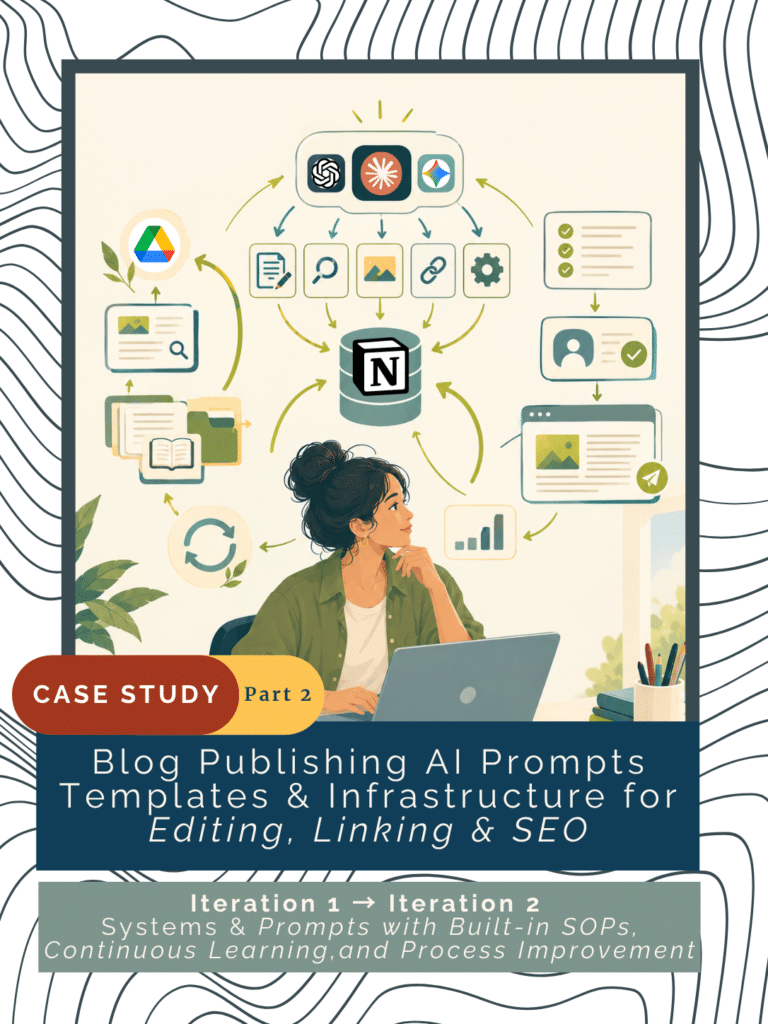
[Expand for Full Series Overview] This is Iteration 2 (Part 1) in Revamping the Prompts and Management Infrastructure of the Blog Publishing Workflow.
This revamp builds on the first stage of Nivationist’s manual-to-AI-assisted implementation, “Blog Publishing Workflow With Claude AI: Cutting Time by 36%.” While the first stage focused primarily on reducing production time, this next stage moves beyond the time reduction metric by embedding parameters, SOPs, and management infrastructure into the AI-assisted workflow. The goal is to standardize how AI supports each publishing phase (e.g., final editing, identifying highlights, internal/external link suggestions, SEO, and image generation) while teaching AI to work within Nivationist’s voice, brand, strategy, and work habits, including learning while executing.
- Part 1: Standardized Publishing Architecture & Operational Pain Points
- An inside look at the friction that reshaped each stage of the blog publishing workflow. We trace the journey from task-specific AI prompts to standardized, modular processes, showing how scoped AI discovery, richer resource and reference integration, continuous improvement practices, and modular SOP/prompt management became foundational to a more scalable publishing infrastructure.
- Part 2: Prompt Transformation, Multi-AI Execution & Infrastructure in Action
- A step-by-step walkthrough of how the new publishing infrastructure was actualized. Featuring before-and-after prompt comparisons and reusable templates, platform experiments across Claude, ChatGPT, and Gemini, and connected Notion database schemas. It shows how each publishing phase was transformed from an individual AI task into a standardized, repeatable, and continuously improvable workflow.
Core Innovations in this Revamp
Embedded Workflow Standardization via SOP-Driven Prompts: Engineered standardized operating procedures (SOPs) directly into system prompts, enforcing consistent formatting, tone, and operational guidelines across automated workflows.
Human-Approved Decision Gates: Shifting AI from autonomous execution to structured editorial support—utilizing severity markers, reasoning, and pre-execution confirmations so human decision-making remains front and center.
Dynamic Resource & Link Diversification: Formulated advanced prompting strategies to dynamically serve varied, contextually relevant link resources, preventing repetitive recommendations and enhancing content depth.
Connected Database Infrastructure: Replacing static, copy-pasted Notion tables with dynamic, filtered database views to manage internal and external assets without adding maintenance overhead.
Modular Prompt Optimization: Developed reusable, structured prompt modules that streamline iteration, reduce latency, and maintain brand voice across diverse content channels.
Best-Fit Multi-AI Orchestration: Strategically distributing workflow steps across Claude, ChatGPT, and Gemini based on platform strengths (such as database scanning vs. image generation) while utilizing shared instruction layers to eliminate repetitive context.
Dual-Purpose Execution & Learning: Structuring complex tasks like SEO into multi-phase workflows that simultaneously generate optimized metadata and deliver best-practice learning to the creator.
Controlled Visual Identity Systems: Moving away from unpredictable image generation by establishing reusable reference catalogues and mandatory concept selection prior to final asset rendering.
All Posts in this Series
[Current Post] Streamline Content Operations: An AI Blog Publishing SOP
[Next Post] AI Blog Publishing SOP: Prompts that help You Learn/Automate
- CONTEXT
- THE CURRENT BLOG PUBLISHING AI PROMPTING SYSTEM
- GOALS
- CONSTRAINTS
- PAIN POINTS, NEW NEEDS, DOWNSIDES, & SOLUTIONS
- Blog Publishing – AI Prompt Revamp Process
- AI Proofreading Redesign: From AI-Led Editing to Structured Recommendations with Human Editorial Approval
- SEO Workflow Expansion: From Metadata Generation to People-First SEO Execution, Learning, and Continuous Improvement
- Link Strategy Redesign: From Repetitive External Suggestions to Diverse, Reader-Value-Driven Link Curation
- Visual Consistency System: From Repeated Reference Attachments to a Reusable, Rotating Style Catalogue
- Blog Publishing – System Infrastructure Revamp Process
- AI Operations Redesign: From Manual Prompt Setup to a Modular, Swappable AI Workflow System
- Link Management Redesign: From Static Link Tables to a Scalable, Database-Driven Link Management System
CONTEXT
Content Operations: Evolution and Current Stage
Nivationist officially launched and began content operations in April 2026. [1] At the time, we had a full blog idea repository compiled over three years of Nivationist’s development [2] and a backlog of five ready-to-publish blog series (20 blog posts totaling nearly 260 pages) written within a year (March 2025 to March 2026). [3]
During the one-year writing period, we created a reusable blog-writing template and established a standardized list of features to include (e.g., post highlights, toggle menus, excerpt examples, etc.). This laid the groundwork for identifying ways to incorporate these content features and standardize blog post formatting and publishing.
By May 2026, we built all blog feature components into components or templates saved as reusable patterns for WordPress. [4] Join the Nivationist newsletter to get behind-the-scenes before-and-after iterations like this one in your inbox.
However, the blog publishing process (e.g., final proofreading, identifying highlights, SEO, Google Doc-to-WordPress formatting, link suggestions, featured image creation, and final pre-publish review) was 100% manual and completely memory-reliant. This resulted in the time it took to publish a single blog post being more than 3 hours long. [5] The sustainability of the goal to consistently publish blogs on a bi-weekly schedule is in question.
To increase efficiency and standardize output, a current system analysis was conducted in Claude AI, learning on how to write, use, and edit AI prompts was initiated, and a live stress test on the blog publishing production workflow using Claude AI prompts and other supporting AI platforms (e.g., Gemini and ChatGPT) was created. [5]
This resulted in significant productivity gains of ~93% across the following blog publishing steps: final editing, highlight identification, link suggestions, and SEO.
However, incorporating a critical human review step after AI output to ensure accuracy brought net time savings to 50%. When accounting for the full end-to-end workflow, including Google Doc-to-WordPress formatting, image generation, pre-publish checks, and database updates, the overall process achieved a ~36% reduction in total production time. [5]
The new iteration of the blog publishing revamp seeks to streamline the human review process by implementing general AI rules that support work habits, thought processes, and learning agendas, while strengthening quality control and standardization through built-in quality checklists, mandatory approval criteria, targeted, scope-limited resource discovery, and connected database referencing.
These improvements aim to reduce operational inefficiencies, improve content consistency and reliability, strengthen knowledge retention, and establish a scalable, repeatable content operations system that delivers value beyond simply reducing production time.
THE CURRENT BLOG PUBLISHING AI PROMPTING SYSTEM
Before Nivationist officially integrated AI into its content operations system, AI prompt design and AI tools for content production were relatively new.
The case study of the first iterative revamp of the blog publishing workflow explains the initial evolution from fully manual to AI-assisted with post-human review.
This iteration served as an in-execution opportunity for learning prompt design, understanding the use of high-level AI deployment, and uncovering the limitations of Claude AI by testing its Free Plan prior to investment. [5]
This led to the first batch of AI prompts becoming a combination of a generative output after a current system analysis, followed by human-led editing for better tailoring to the day-to-day work habits and Nivationist’s operative vision, resulting in an overall ~36% reduction in production time for the blog publishing workflow.
The core deliverables for the blog publishing steps (e.g., final proofreading, identifying highlights, SEO, Google Doc-to-WordPress formatting, link suggestions, featured image creation, and final pre-publish review) are successfully addressed to generate satisfactory outputs.
However, additional infrastructure (e.g., linking procedures, SOPs, quality checklists, database referencing) needs to be further implemented, and criteria need to be better defined (e.g., more examples, definitions, and clarification) to generate a standardized, consistent output beyond just a reduction in production time.
Additionally, some instructions within the prompts contain requests that aren’t deployable or are heavily limited within Claude AI’s free plan during the experimental, transitional phase of trying out AI for the first time in content operations.
This requires the removal of unnecessary instructions, clarification/elaboration of all components of the prompts, building a centralized prompt management system, prompt-to-system integration, SOP-to-prompt integration, and multi-AI use/support to offset Claude AI limitations. Explore Anthropic’s prompt engineering guide to see how clearer instructions and examples make your own prompts more reliable.
GOALS
Goal 1: Human–AI Collaboration
- Support Human-Led Review: Shift AI-assisted workflows from AI-led execution toward human-approved decisions, using general AI rules that support established work habits, thought processes, and learning agendas while keeping the user as the final decision-maker. See practical patterns for adding approval checkpoints to AI workflows, so you stay the final decision-maker.
- Build Learning Into Execution: Turn workflows such as SEO and final proofreading into opportunities to understand why recommendations are made, improve the process itself, and strengthen knowledge retention.
- Match AI to the Workflow: Map each workflow step to its best-fit AI platform while maintaining shared instructions that preserve consistent Nivationist standards across platforms.
Goal 2: Quality & Content Reliability
- Strengthen Quality Control & Standardization: Embed quality checklists, mandatory approval criteria, and structured review formats throughout the workflow to improve consistency and reliability.
- Improve Content Consistency & Reliability: Establish repeatable standards across editing, SEO, links, featured images, and other publishing requirements so quality does not depend on manually remembering every rule.
- Make Resource Discovery Targeted & Scope-Limited: Define appropriate research scope, resource types, and limits for each workflow step to prevent unnecessary research and information overload.
Goal 3: Workflow & System Infrastructure
- Connect AI to the Content Operations System: Connect prompts to relevant databases and views so AI can reference current, structured information rather than relying on manually copied context or static resources.
- Reduce Operational Inefficiencies: Minimize unnecessary manual steps, context switching, repeated information entry, and workflow maintenance.
- Create a Sustainable Publishing Workflow: Reduce operational friction and manual upkeep so the bi-weekly publishing schedule becomes more realistic and sustainable.
- Build a Scalable, Repeatable Content Operations System: Create an orchestration layer connecting workflow steps, databases, AI platforms, shared instructions, review checkpoints, and reusable resources. Explore how scattered tools became one connected system so you can build your own orchestration layer.
Goal 4: Long-Term Operational Value
- Strengthen Knowledge Retention: Use the workflow itself as a mechanism for retaining editorial knowledge, decision-making logic, and lessons learned rather than treating AI as an output-only tool. Pick up Building a Second Brain to learn how to capture and reuse your notes so lessons stick instead of getting lost.
- Deliver Value Beyond Production-Time Savings: Optimize the system not only for speed, but also for better decision-making, consistency, reliability, learning, knowledge retention, and scalability.
- Enable Sustainable Growth: Establish a repeatable foundation that can support increasing content volume and complexity without requiring a proportional increase in manual effort.
CONSTRAINTS
Constraint 1: Capacity & Resources
- Limited Budget: The operation relies substantially on free or already-owned tools rather than a large software or automation budget. The solution should maximize the existing technology stack before introducing additional paid infrastructure.
- Solo Operator: Nivationist’s content operation is currently managed by one person rather than a team with specialized roles, meaning the system must account for limited capacity across content production, review, maintenance, and improvement.
- Limited Time & Attention: The same person responsible for producing content is also responsible for maintaining and improving the system. Any added process therefore needs to provide enough value to justify its additional time and cognitive load. Build a system that works for the overwhelmed blogger so maintenance never becomes another full-time job.
Constraint 2: AI & Technology Limitations
- Free-Plan AI Limitations: Usage, prompt, and feature restrictions make it impractical to run the entire workflow through a single AI platform. The system therefore needs to distribute work across multiple platforms according to their strengths without creating excessive context-switching or manual copying.
- Existing Technology Stack Should Be Reused: The current Notion, Readwise, and Google Docs setup should be extended rather than replaced to limit implementation time, disruption, and unnecessary system rebuilding.
- AI Must Work Within Defined Scope: AI-assisted research and generation need clearly defined boundaries so limited usage is not consumed by unnecessary resource discovery, repeated context, or work outside the current workflow step.
Constraint 3: Human & Editorial Control
- Human Keeps Final Editorial Control: AI outputs cannot be treated as automatically approved. Proofreading, link recommendations, featured-image concepts, and other AI-assisted decisions require human review and approval.
- Brand Voice Must Be Preserved: The system must consistently maintain Nivationist’s honest, warm, and encouraging voice rather than allowing standardized AI rules to flatten or replace the brand’s editorial character.
- Review Effort Must Remain Manageable: Every additional approval point introduces cognitive load and review time. Human oversight therefore needs to be structured in a way that makes decisions easier to scan, evaluate, and act on.
Constraint 4: Sustainability & Scalability
- Bi-Weekly Publishing Must Remain Sustainable: The system should support a realistic bi-weekly publishing cadence without requiring an unsustainable increase in production, review, or system-maintenance effort. The feasibility of maintaining this schedule remains an open constraint.
- The System Must Scale With Content Volume: Workflow improvements cannot solve current inefficiencies by introducing processes that become increasingly difficult to maintain as the volume of content, links, assets, and references grows.
- The System Must Be Standardized & Low-Maintenance: With new business plans beginning next year, the content operation needs repeatable standards and low-maintenance processes that can continue operating without constant manual intervention.
Constraint 5: Content & Information Standards
- Source Credibility Matters: Research, links, and other external resources must meet appropriate standards for credibility and usefulness rather than being selected solely because they are relevant or easy for AI to find.
- Knowledge Should Remain Traceable: The system should preserve the connection between sources, AI recommendations, human decisions, and final content so information does not become disconnected from its original context.
PAIN POINTS, NEW NEEDS, DOWNSIDES, & SOLUTIONS
Blog Publishing – AI Prompt Revamp Process
The blog publishing workflow currently contains the following AI prompts:
- Proofreading & Identifying Highlights: This workflow makes final edit suggestions for grammar and spelling within the final draft of the blog post, followed by identifying key insights that should be highlighted within the post prior to the publishing of the post.
Current Prompt Outline:
- Role: This section of the prompt defines the role in which AI would need to assume for the task and a description of Nivationist’s brand voice.
- Task: This section explains the criteria, the desired output, and dos/don’ts for the two blog publishing steps: proofreading and highlight identification.
- Blog Post Title: A placeholder to insert the blog title.
- Blog Post: A placeholder to insert the entire blog post content.
- What to do with the Output: Shows what AI should implement from the prompt, and AI is allowed to make the final call.
AI Proofreading Redesign: From AI-Led Editing to Structured Recommendations with Human Editorial Approval
The prompt for proofreading and identifying highlights in the first iteration generated a list of suggested edits and highlights without enough context to efficiently evaluate or implement them.
The original text wasn’t provided to help me easily locate the issue and change it within the blog post. Additionally, there’s variability in whether the reason for the edit is given or not.
The prompt should always provide the level of severity and reason for the edit to quickly gauge the flexibility of my final decision at a glance and shorten the human review process with more context support.
Additionally, the prompt allows the AI’s recommendation to become the final editorial decision. There was no structured review step requiring me to explicitly accept, reject, or modify each suggestion before it became part of the editing process.
Shift AI proofreading from an AI-led editing process to a human-approved editing process that’s implementation-friendly.
Each recommendation should provide the original text, suggested revision, reason, and severity organized within an easy-to-read table so I can evaluate the recommendation in context and make the final decision.
The workflow should allow me to accept, reject, or modify each suggestion, with the option to use Find & Replace in Google Docs or automate approved changes when appropriate.
Adding a human approval layer creates an additional review step and requires more structured output from AI. There’s an initial investment to rewrite, organize, structure, and provide detailed definitions/clarified requests within the prompt to ensure consistent output.
Redesign the proofreading workflow so that AI identifies and explains potential issues but does not make the final editorial decision. Each recommendation will be presented in a table with the following properties:
– Original text: identifies exactly what needs to be located.
– Suggested edit: presents the proposed change.
– Reason: explains why the change is being recommended.
– Severity: an assigned marker that indicates the significance of the issue.
– Human decision: allows the user to accept, reject, or modify the recommendation.
Implementation options:
1. Approved edits can be manually applied through Find & Replace within Google Docs or
2. Automatically apply approved edits and highlights within Google Docs (Claude-AI only).
- SEO: This workflow recommends SEO titles, meta descriptions, WordPress excerpt, focus keyphrases, and other algorithm-relevant components based on the context, user intent, and value expressed within the blog post in accordance with AIOSEO guidelines (the SEO plugin used for Nivationist) prior to the publication of a post.
Current Prompt Outline:
- Role: This section defines the role the AI would need to assume for the task, what Nivationist is about, and a description of the brand voice.
- Task: This section explains the SEO deliverables the AI needs to generate for AIOSEO’s free plan (e.g., SEO title, 1 focus keyphrase, meta description, image alt text, and slug).
- The task further defines the character limits for each SEO field, if applicable.
- Blog Post Title: A placeholder to insert the blog title.
- Blog Post: A placeholder to insert the entire blog post content.
- What to do with the Output: Define the location to place the generated SEO and confirm the slug before publishing.
SEO Workflow Expansion: From Metadata Generation to People-First SEO Execution, Learning, and Continuous Improvement
The original SEO prompt primarily generated a fixed set of metadata fields: primary keyword, SEO title, meta description, slug, and alt text, with limited explanation or guidance for evaluating the recommendations.
It’s useful for generating the appropriate content to populate the SEO fields, but less useful for learning SEO best practices, making informed decisions, or adapting the process as SEO practices continuously evolve.
The prompt was primarily a metadata-generation task, rather than a learning opportunity to learn on the job by maintaining knowledge of understanding the search intent, supporting keywords, content positioning, reader experience, and the relationship between the article and its featured image, and updating the SEO prompt improvements to keep up with the latest practices.
Turn SEO optimization into a 2-in-1 execution and learning-oriented workflow that not only generates SEO elements but explains the reasoning behind them and teaches how to write and make better SEO decisions over time.
The workflow should:
– Determine search intent before generating recommendations.
– Recommend a primary focus keyphrase and supporting keywords.
– Generate and evaluate SEO titles, meta descriptions, slugs, and excerpts against defined criteria (e.g., baseline SEO best practices and latest SEO trends)
– Allow and encourage human review and further editing or approval of recommendations.
– Incorporate featured-image accessibility and SEO considerations.
– Suggest recent, trustworthy SEO resources to support after-task learning.
– Identify opportunities to improve the SEO prompt itself as practices evolve.
The expanded workflow requires more time and produces substantially more information than the original prompt. More recommendations, explanations, learning resources, and approval steps can increase cognitive load and make SEO optimization feel more complicated.
There is also a risk of over-optimizing for SEO or introducing unnecessary changes if recommendations are treated as requirements rather than decision support.
Redesign the SEO prompt as a multi-phase prompt that organizes each component of SEO into manageable sections. The beginning of the prompt will be education-focused with an overview of the latest SEO trends and a review of known SEO knowledge. The middle will be execution-based and will be used to generate, recommend, and encourage modification of all SEO fields. The prompt will conclude with suggestions for improving the SEO prompt.
Additionally, each phase has a defined purpose, criteria, and approval point while maintaining the principle that readers come before search engines. AI will also explain the reasoning and supporting evidence and serve as both an SEO production system and a continuous learning system, rather than simply a prompt for generating metadata. Read Google’s own guidance on people-first content so you can check your SEO choices against what actually serves readers.
- Link Suggestions: This workflow recommends internal and external links to include within the blog post to increase authoritativeness, site crawling (SEO), and helpfulness to the audience.
Current Prompt Outline:
- Role: This section defines the role the AI would need to assume for the task and a soft ask for “no links for the sake of links.”
- Tasks:
- Internal Link Suggestions: Request AI to recommend 2-4 places on the blog post where it can link relevant Nivationist’s internal posts/pages and define the format for displaying the internal link suggestions.
- External Link Suggestions: Additionally, it then requests AI to recommend 2-3 places on the blog post where relevant external resources from the synced Readwise database could be linked and define the format for displaying external link suggestions.
- Link Library: A link for the internal links library and the Readwise database.
- An internal links library template was generated by AI for experimental use in Notion.
- A synced Notion database with all Readwise resources/highlights was ready to be referenced in the prompt.
- Blog Post Title: A placeholder to insert the blog title.
- Blog Post: A placeholder to insert the entire blog post content.
- What to do with Output: Allow human review of each link suggestion by either accepting, adjusting, or skipping the suggestion, and request that all accepted links be added to the blog post located in Google Drive and update all library databases in Notion.
Link Strategy Redesign: From Repetitive External Suggestions to Diverse, Reader-Value-Driven Link Curation
The current knowledge hub contains referenceable resources that primarily originate from me.
– 500+ transcribed notes from my career-building since day 1 of Nivationist’s development.
– External resources with highlights saved on Readwise that I used to build Nivationist.
– Book summaries and notes that nurture my own personal growth journey.
– Nivationist’s blog posts that reference my own notes and external resources collected over the course of Nivationist’s development journey that contain timeless solutions but aren’t recently published, which may be more susceptible to navigation/page errors for their age.
So there is a need to reference recently published, reputable external resources for recency, diversity, continuous learning, external evidence support, algorithm ranking, and potential relationship building with other creators in the field.
However, the suggested external links using the current prompt iteration are highly repetitive across multiple blog posts of similar topics, indicating that the AI tends to only retrieve the top 3-5 high-ranking results. Since most high-ranking results are occupied by large, established agencies, there’s limited opportunity to support lesser-known creators or smaller agencies who also publish high-quality results. This creates a lack of source diversity.
Additionally, most suggested external links are articles, containing little to no videos, podcasts, or book suggestions. This creates a lack of source medium diversity.
The results output generated a list of external links without conducting additional quality checks to see if the links are reputable, error-free, and recent. Adding relevant inbound/outbound links within the post requires creating relevant anchor text, but the prompt didn’t address this need. This adds manual work to write anchor text that aligns with and supports the blog post while also meeting the audience’s needs in each section.
The link suggestions prompt needs to reference three types of links:
– Internal links: Nivationist’s published blog posts, case studies, and pages.
– Readwise: External resources with highlights collected over the course of Nivationist’s development journey.
– [New] External: additional link recommendations outside of Readwise that AI thinks will be great additions in satisfying the audience’s needs.
The prompt needs to evaluate links based on reader value, contextual relevance, source credibility, and whether a link genuinely belongs in the article, while encouraging human review before anything is implemented. Requests to encourage AI to increase diversity in resource allocation (e.g., medium, source, etc.)
It should generate relevant anchor text and show where the anchor text and its accompanying links (internal, Readwise resources, and external) should go within the blog post.
Adding a link category, especially one that searches outside of a pre-assessed list of resources, means additional overhead in personally evaluating the legitimacy and credibility of the suggested resources, which increases human review time. The same overhead is also true for evaluating the accuracy of anchor text generation.
This also creates the possibility of over-curating resources, generating too many recommendations, or adding unnecessary review steps.
Include specific guidelines to increase diversity of external link suggestions, conduct recency/page-error analysis before delivering output, and separate the link suggestion task into three phases: Internal Links suggestion, Readwise link suggestion, and External link suggestion to organize and break down the human review and evaluation into manageable chunks.
Limit the number of suggested links for each link category to reduce excessive recommendations and prolong human review time. Additional criteria on what makes a good anchor link will be added.
Have all links be displayed within a table that displays the suggested link, its respective anchor text, the preceding sentence in which the link should be included in the blog post, and the reason why the link was recommended.
All link categories will have their own dedicated database or filtered database view. Its URL will be referenced within the prompt.
There’s also an optional step within the prompt that allows it to automatically add all approved link suggestions along with their anchor text into the blog post.
- Featured Image Generation: This workflow generates images to be used as the featured image of a blog in adherence to an established brand design language.
Current Prompt Outline:
- Task: Describe the featured image generation task and reference the post title.
- Brand Style: Describe the image design/visual/art style for consistency of output based on previously published featured images.
- Brand Colors: List the established hex codes for Nivationist’s brand colors.
- Image Criteria: Describe the overall image vibe and design language.
- Reference the Style of Previous Post Image: Describe or paste the previous image description or file.
- Tip (for reminder): Always store the image style description to reuse in the next image generation.
Visual Consistency System: From Repeated Reference Attachments to a Reusable, Rotating Style Catalogue
A consistent art style needs to be established, which requires a collection of good reference images. However, the prompt itself is unable to realistically describe or always carry over a large array of reference images for each image generation. The consistency of the images generated varies. Attaching images in prompts heavily consumes the limit for the Free plan.
Additionally, there is a lack of knowing what the AI is planning to generate because the generation of images is immediate upon submission of a request, and the final image is subject to randomness and often a maximum of three tries before the Free plan limit is hit.
There’s a need to create a referenceable catalogue of good reference images instead of attaching the images to the prompt each time. An AI request to pause the immediate need for image generation and instead list 2-3 image concepts that can be chosen is essential. Additionally, a strict ask to limit new rounds of image generation strictly to the current prompt, instead of the most recent or incorporating the entire chat as reference, is critical to ensure that the image generated is as expected and within a controlled scope and with the right context to avoid unexpected image generation.
The referenced collection of good images contains AI-generated images that satisfy the final output. This could limit the expressive scope of future image generations, making some images look too similar and not distinctive.
Establish a controlled, reusable image-reference system that separates art-style consistency from individual image concepts. Instead of repeatedly attaching reference images or relying on the entire chat history, maintain a curated reference catalogue by including the following prompt components:
Reference Catalogue: Maintain a small, curated collection of approved images that define the Nivationist visual language (e.g., character design, illustration style, composition, color treatment, line quality, and overall visual feel). The catalogue serves as the persistent source of truth for style rather than requiring every reference image to be attached to every prompt.
Concept Approval Before Generation: Require AI to first propose 2–3 distinct image concepts based only on the current prompt and the designated reference catalogue. No image should be generated at this stage. The user selects or modifies a concept before generation begins.
Controlled Generation Scope: Once a concept is approved, generate the image using only the current prompt, the selected concept, and the explicitly designated reference images. The AI should not automatically carry forward unrelated imagery, concepts, or instructions from earlier in the conversation.
Reference Catalogue Rotation: Periodically review and refresh the catalogue rather than treating successful AI-generated images as permanent templates. This preserves the established visual identity while preventing the reference collection from becoming so narrow that future images become repetitive or visually indistinguishable.
Blog Publishing – System Infrastructure Revamp Process
The AI prompt management system is currently organized as follows:
- Prompts Stored in Google Docs: Each key component of the content operations (e.g., blog publishing, newsletter publishing, idea curation) system has its own Google Doc file. See how Claude AI helped cut newsletter curation time by 62% so your own newsletter workflow runs faster.
The initiation of a workflow begins by navigating to the appropriate Google Doc and following the sequence of the tabs (mirroring the sequence of the workflow steps). Each workflow step requires copy/pasting the prompt from the Google Doc into a new chat on an AI platform.
AI Operations Redesign: From Manual Prompt Setup to a Modular, Swappable AI Workflow System
Content operations rely heavily on manually copying prompts from Google Docs into new AI chats. This creates repetitive setup work. It also creates unnecessary pressure on the Free Plan limit of any one platform, even if a workflow or workflow step may be better designated to a specific AI platform best suited for use.
Without a shared layer of context, each AI platform may also require repeated instructions about Nivationist, its brand voice, the user’s preferred working style, and how learning and actions should be handled.
Create a database that documents the workflow, including its steps in sequence, reference links to each workflow step, and other resources (e.g., quality checklists, task templates, etc.).
An experiment to identify which AI platform is best suited for which workflow step is required. After the results are in, create projects or notebooks (reusable prompts) that are stored directly within the AI platforms best suited to each workflow or workflow step. This approach strategically distributes the Free Plan usage and reduces repetitive copy/pasting.
Additionally, it’s essential to establish a high-level instruction layer that will be stored as general instructions within each AI platform to provide consistent cross-platform context.
This high-level prompt will include a description of: Nivationist’s brand voice and purpose, the user’s preferred work habits and output presentation, AI personality, learning-while-executing expectations, and automatic extraction of actionable items into a post-conversation action summary.
Distributing prompts across multiple AI platforms can make the system harder to maintain and may create inconsistencies if shared instructions are duplicated or become outdated. Platform-specific reusable prompts can also become disconnected from the central workflow unless their relationships are clearly documented. A broad instruction layer may additionally influence tasks where certain instructions are irrelevant, creating unnecessary context.
Maintain a high-level, reusable instruction framework that establishes Nivationist context, brand voice, AI personality, work habits, learning mode, and action-extraction behavior across workflows.
The workflow database serves as the orchestration layer, identifying which AI engine, reusable prompt, resources, and sequence belong to each step. This separates stable cross-workflow context from task-specific instructions, allowing prompts and AI platforms to remain swappable as the system evolves.
Build a modular, easy-to-update AI workflow database. Store the Google Doc links of the prompts to their respective workflow step within the database and only create reusable prompts within AI platforms that are best suited for the execution of the step in accordance with the results of the experiment. Since the prompt is stored within Google Docs, not directly within Notion, it is easy to add comments and suggestions for improvement and be further consolidated/prioritized as future tasks.
Approach in Prompt Usage: The prompt is multi-leg; it includes all of the blog publishing workflow steps. When initiating the prompt for the entire blog publishing process, the entire prompt is copied and pasted into Claude AI every time a blog post needs to be published.
Approach in Reporting Troubleshooting & Improvement Suggestions in Prompts: During each prompt execution, the AI output will be reviewed, and the line of the prompt that requires modification will be highlighted and commented on. During a designated review, all comments, accompanied by their highlighted line of the prompt within the doc, will be extracted and consolidated into another tab within the same doc using Gemini. The consolidated list of troubleshooting and improvement fixes will be relayed to Google Keep and then to Google Tasks for execution using Gemini.
- Readwise Database: This database is synced with Readwise and contains saved online resources filled with highlights that were collected over the course of my personal growth journey and Nivationist’s development.
[Generative] Approach for External Resource: Any relevant, external source must be updated in the “Research Sources” section to be used in future content production. This library will be used alongside the blog publishing prompt.[6]
This approach wasn’t utilized due to its at-a-glance limitations and execution inconvenience. The Readwise database will be referenced, and a custom AI prompt for external link suggestions (beyond Readwise) was implemented (see below).
Approach in Readwise Database Usage: The Readwise database is used at the following content production points:
1.) When compiling resources to gauge the maturity of a blog idea for content production.
3.) When selecting ideas and writing the blog, the Readwise database is linked with the Blog Idea Library database to easily select and reference relevant resources.
2.) To select relevant resources to link to the final blog post. An internal search within the Readwise database using keywords is conducted to filter for relevant resources to include within the post.
The Readwise database is a part of the Knowledge Hub: Multiple streams of resources consolidated into a collection of databases that could be reused and ever-expanded. The use and implementation of the Readwise database system will stay the same.
- Internal Links Library: This library was a Notion page generated by Claude AI as 1.) an all-in-one management system for all published blog posts and newsletters, and 2.) a quick jot-down for newsletter stories to be published for the week. [6]
[Generative] Approach for Using the Internal Links Library: Claude AI generated this library. In every blog publishing session, copy and paste the complete internal links table and the Readwise database into the prompt or as a context file to suggest links relevant to the post. [6]
[Generative] Approach for Updating Published Blog Post: After a blog post has been published, I would need to update the table to maintain its single source of truth. This library will be used alongside the blog publishing prompt. [6]
This approach wasn’t utilized due to its at-a-glance limitations and execution inconvenience. A complete internal links library was built, and a custom AI prompt for link suggestions was implemented (see below).
Link Management Redesign: From Static Link Tables to a Scalable, Database-Driven Link Management System
The link management tables generated by Claude AI are static. Therefore, it can’t be dynamically connected to the growing content library and other components of the content operations system. It will become increasingly difficult to keep updated, search efficiently, and reliably identify the most relevant resources as the number of published posts increases, making scalability difficult.
Additionally, having all links from external research, published blog posts, and newsletter stories makes the page unnecessarily busy and difficult to scan because there are no barriers of separation between tasks that are long-term, short-term, stationary, or warrant a quick jot down. It could lead to misplacements, errors, and discoverability issues as the tables expand in the future.
Create a separate link management database for blogging and newsletters. Filter databases into distinctive views that align with varying link management responsibilities and use cases that are appropriate for the length, frequency, and nature of the task.
The addition of databases with views could be continuously updated and searched as content grows, while giving AI a controlled source of truth for internal and external link recommendations.
Instead of having to manually copy/paste an increasingly long table every time the link suggestions prompt is initiated, the links or titles of specific databases or database views could be referenced within the prompt.
A database-driven workflow introduces more system structure and maintenance than a simple static table. Separating internal links, Readwise resources, and new internet recommendations can also make the workflow more complex if the scope for each use case is not clearly controlled.
Despite additional system structure and maintenance upfront, managing links in a database instead of a static table prevents increasingly more expensive upkeep in the future. The advantage of staying with a static table system is relatively short-lived, as Nivationist is expected to implement new business plans beginning next year, so the content operations system needs to be standardized and sustainably maintained to free up time and resources.
To reduce system-build time, existing databases are reevaluated for new implementations of use.
Implementation of Internal Links Library into Existing Blog Management Database: The blog ideas repository and progress management database in Notion will add a view filtered to only show published blog posts. This published blog post filtered view will become the Internal Links library and be referenced within the Link Suggestions prompt.
Implementation of External Research Resources into Readwise: There is no need to have a separate database or table to store links of external research resources. All external resources found during research will be saved to Readwise, which will be automatically synced to a Readwise database in Notion. This Readwise database will then be referenced within the Link Suggestions prompt.
Footnotes
[1] Ming Zheng, the creator behind Nivationist, shows April 2026 as the estimated start date of her creative operations in Nivationist on her LinkedIn profile. https://www.linkedin.com/in/ming-xue-zheng/details/experience/
[2] Ming Zheng, the creator behind Nivationist, shows November 2022 as the estimated start date of development on Nivationist on her LinkedIn profile https://www.linkedin.com/in/ming-xue-zheng/details/experience/, and the year was supported on the Nivationist About page. https://nivationist.com/about/
[3] Blog post that shows the number of blog posts, blog series, and pages written for Nivationist from March 2025 – November 2025. Additional blogs have been written after this post was written and have been included in this case study’s calculation for total content written from March 2025 – March 2026. https://nivationist.com/redirection-after-burnout-rebuild-a-sustainable-workflow/
[4] The Nivationist Newsletter #002, released on May 9, 2026, “Before/After Iterations,” explains the experimentation and standardization I’ve done in WordPress to increase consistency in content format. https://preview.mailerlite.io/preview/749948/emails/186565271869195685
[5] The first iteration of this case study was documented. Under “The Goals of this Workflow Revamp,” it explained the manual nature of the process before the revamp and the previous time it took to publish a blog. The calculation process and success metrics are presented under “Step 5: Calculating Results” https://nivationist.com/blog-publishing-workflow-with-claude-ai-cutting-time-by-36/
[6] The Internal Links Library generated by Claude AI. https://app.notion.com/p/Public-Nivationist-Link-Library-361f04ebfaa481eea92ee786ce62b20e
🔗 See What to Explore Next [toggle/expandable section]
All the Posts in this Series
[Current Post] Streamline Content Operations: An AI Blog Publishing SOP
[Next Post] AI Blog Publishing SOP: Prompts that help You Learn/Automate
Summary of This Case Study Series
During the early stages of Nivationist, a simple system worked well enough to collect ideas and draft early blog posts. But after launching official blogging operations, that fragmented setup quickly hit its limits. This two-part case study details how we rebuilt Nivationist’s content operations from the ground up, transforming an ad-hoc idea collector into a scalable, end-to-end production engine.
- Part 1: Standardized Publishing Architecture & Operational Pain Points: An inside look at the friction that reshaped each stage of the blog publishing workflow. We trace the journey from task-specific AI prompts to standardized, modular processes, showing how scoped AI discovery, richer resource and reference integration, continuous improvement practices, and modular SOP/prompt management became foundational to a more scalable publishing infrastructure.
- Part 2: Prompt Transformation, Multi-AI Execution & Infrastructure in Action: A step-by-step walkthrough of how the new publishing infrastructure was actualized. Featuring before-and-after prompt comparisons and reusable templates, platform experiments across Claude, ChatGPT, and Gemini, and connected Notion database schemas. It shows how each publishing phase was transformed from an individual AI task into a standardized, repeatable, and continuously improvable workflow.
Core Innovations in this Revamp
Embedded Workflow Standardization via SOP-Driven Prompts: Engineered standardized operating procedures (SOPs) directly into system prompts, enforcing consistent formatting, tone, and operational guidelines across automated workflows.
Human-Approved Decision Gates: Shifting AI from autonomous execution to structured editorial support—utilizing severity markers, reasoning, and pre-execution confirmations so human decision-making remains front and center.
Dynamic Resource & Link Diversification: Formulated advanced prompting strategies to dynamically serve varied, contextually relevant link resources, preventing repetitive recommendations and enhancing content depth.
Connected Database Infrastructure: Replaced static, copy-pasted Notion tables with dynamic, filtered database views to manage internal and external assets without adding maintenance overhead.
Modular Prompt Optimization: Developed reusable, structured prompt modules that streamline iteration, reduce latency, and maintain brand voice across diverse content channels.
Best-Fit Multi-AI Orchestration: Strategically distributing workflow steps across Claude, ChatGPT, and Gemini based on platform strengths (such as database scanning vs. image generation) while utilizing shared instruction layers to eliminate repetitive context.
Dual-Purpose Execution & Learning: Structuring complex tasks like SEO into multi-phase workflows that simultaneously generate optimized metadata and deliver best-practice learning to the creator.
Controlled Visual Identity Systems: Moving away from unpredictable image generation by establishing reusable reference catalogues and mandatory concept selection prior to final asset rendering.