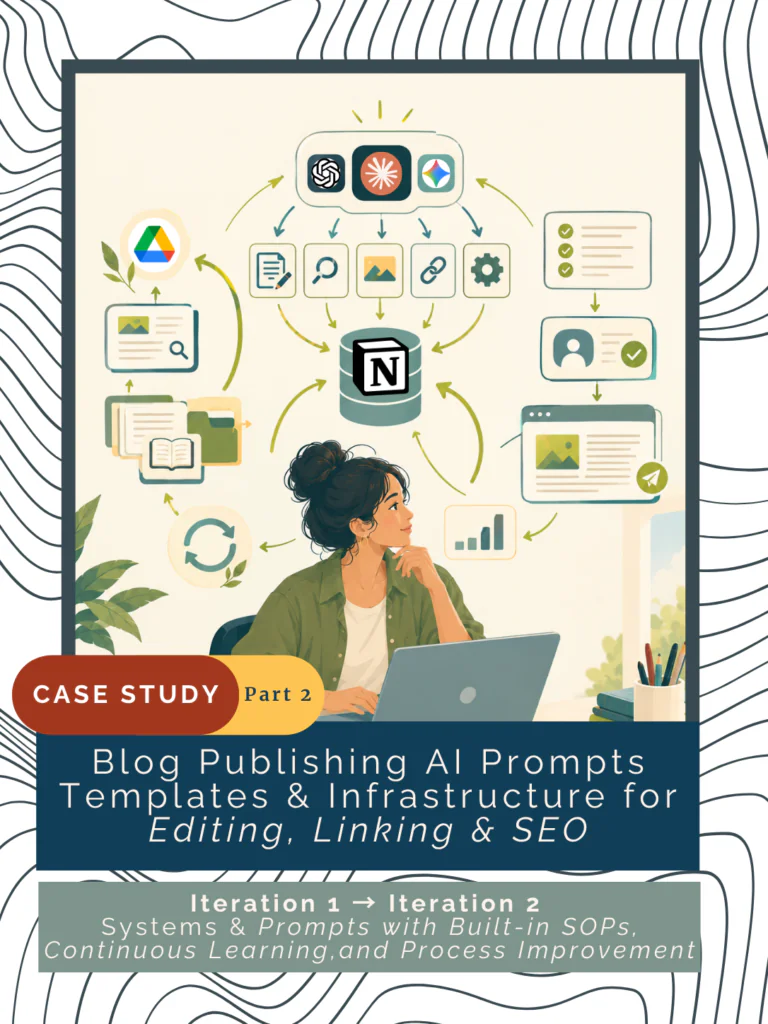
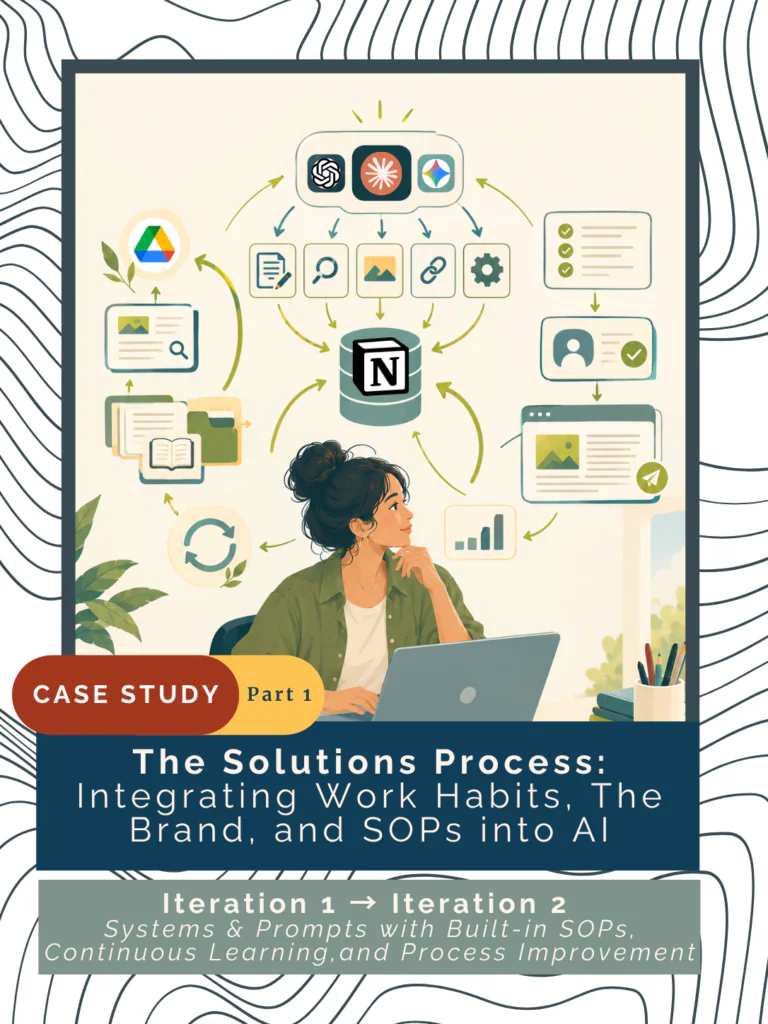
[Expand for Full Series Overview] This is Part 1, the prologue of the Case Study, “Content Operations System: Scale Without Losing Authenticity.”
During the early stages of Nivationist, a simple system worked well enough to collect ideas and draft early blog posts. But after launching official blogging operations, that fragmented setup quickly hit its limits. This two-part case study details how we rebuilt Nivationist’s content operations from the ground up, transforming an ad-hoc idea collector into a scalable, end-to-end production engine.
- Part 1: Strategic Blueprint & Systems Architecture: An inside look at the inflection points that forced a total system rethink. We map the journey from initial operational pain points to business-aligned solutions, showing how personal workflow habits and strategic growth goals shaped the new pipeline.
- Part 2: Build, Execution & Database Design: The step-by-step walkthrough of the new architecture in action. Featuring before-and-after workflow diagrams, automated actions, and database schemas, this post reveals how the proposed solutions were actualized.
Core Innovations in this Revamp
Systematized Prioritization & Planning: A predictable, repeatable matrix for content intake, scheduling, and execution.
Authentic Brand & Ownership Controls: Structural guardrails designed to maximize automated operational efficiency without surrendering content ownership or core brand voice.
Modular, Swappable SOP Workflows: Flexible, sequential production steps powered by custom AI prompts and standardization toolkits.
Closed-Loop Single Source of Truth: Structural end-of-workflow verification gates that guarantee single-truth accuracy across all assets.
Deliverable-Driven Progress Tracking: Replacing subjective status updates with tangible output milestones.
Dual-Layer Content Management: Clear, explicit separation between macro strategy and micro content execution.
Universal AI Engine: Standardized prompting protocols engineered for active learning, iterative refinement, and automated action generation.
All the Posts in this Series
[Current Post] Content Operations System Revamp: Fragmented to Centralized
[Next Post] Content Operations System: Scale Without Losing Authenticity
- CONTEXT
- GOALS
- CONSTRAINTS
- THE CURRENT BLOG MANAGEMENT SYSTEM
- PAIN POINTS, NEW NEEDS, DOWNSIDES, & RESOLUTIONS
- Proactive AI Prompting: Moving from Reactive Tweaks to In-Workflow Optimization
- Decoupling AI Execution from Workflow Management: Moving from Single-Tool Constraints to a Modular System
- From Lost Observations to Actionable Tasks: Low-Friction Optimization During Execution
- From Static Idea Repositories to Intelligent Content Rediscovery: Resurfacing Buried Blog Ideas Without Manual Scrolling
- Replacing Manual Keywords with Core Principles: Using Core Principles to Support Content Branching
- Evidence-Based Progress Tracking: Replacing Manual Status Updates with Tangible Deliverables
- From Passive Repositories to Decision-Support Views: Rebuilding Notion Around Actionable Use Cases
- Summary of Pain Points, Solutions, and Long-Term Initiatives
CONTEXT
Content Operations: Evolution and Current Stage
Nivationist’s blog components (e.g., features, UI, templates, etc.) have been defined after publishing its first set of content starting in May 2026 [1] and standardizing key content components into reusable template blocks in WordPress [2].
Although the per-blog-level components are defined, the blog publishing operation (proofreading, identifying highlights, link suggestions, SEO, WordPress formatting) was manual and relied heavily on memory. This led to the first iteration of the blog publishing process, standardizing and automating workflows using Claude AI prompts, and cutting the time it takes to publish a blog by 36%. [3] [4]
However, the system-level content operations (e.g., data governance, interlinked databases, SOPs, sequence of workflows, universal AI prompts) are fragmented and resistant to closed-loop integration.
This calls for a second iteration of the blog publishing process, with a broader system-level scope to integrate AI (Claude, Gemini, ChatGPT), interlink old/new systems (Notion), and build a standardized, closed-loop content operations pipeline. Follow along as I turn this system into a closed-loop content operation by joining the Nivationist newsletter.
GOALS
Goal 1: Content Strategy & Scalability
- Turn a blog idea repository into a content operating system: Expand the database beyond idea storage and status management into a scalable system that supports discovery, planning, production, publishing, and improvement.
- Increase actionability: Turn databases toward determining what to explore, prioritize, plan, execute, and improve instead of just storing information. See how to turn a blog purpose into a content plan you can act on, so your ideas don’t stay stuck in a repository.
- Scale content production without proportionally increasing mental effort: Reduce the administrative and cognitive overhead required to maintain a growing content operation. Explore how to build a simple system for your blog that keeps overwhelm from taking over as your content grows.
- Broaden the database’s scope and variety of use: Create multiple purposeful ways to use the database so it supports the evolving needs of Nivationist’s content operation rather than functioning primarily as a blog idea repository.
Goal 2: Content Discovery & Repurposing
- Increase searchability/discovery: Merge new and legacy ideas so it’s easier to find, evaluate, and reconnect with current business priorities and content needs.
- Distinguish legacy/ fresh ideas: Preserve the value of Nivationist’s accumulated idea reservoir while making newer ideas and current priorities easier to identify.
- Enable blog idea branching/repurposing: Use the Nivationist Principles as flexible perspectives for turning one idea into multiple content angles and opportunities.
- Preserve the blog idea traceback journey: Maintain a clear connection between a blog post’s original inspiration, supporting knowledge, production process, and final publication.
Goal 3: Workflow & Operational Efficiency
- Reduce unnecessary manual upkeep: Remove administrative updates that add unnecessary maintenance without meaningfully improving visibility, decision-making, or productivity.
- Minimize tool-switching/open tabs: Connect workflows, prompts, resources, and destinations more intentionally to reduce friction when moving through each step of a workflow. Learn how the hidden cost of switching between tasks adds up, and why keeping steps in one place protects your focus.
- Redesign around natural work behavior: Organize the system around the actions and decisions that naturally occur during content creation instead of arbitrary status updates that reduce focus between workflow steps.
- Externalize operational memory: Move workflow knowledge, prompts, resources, decisions, and improvement opportunities out of personal memory and into a reusable, single-truth system. Listen to David Allen explain why getting ideas and commitments out of your head and into a trusted system frees you up to think.
Goal 4: System Architecture & Governance
- Create clear level-to-scope-to-tool distinctions: Clarify what belongs at the business, workflow, task, and execution levels so each platform has a defined role.
- Build a closed-loop content operation system: Connect capture, production, publication, feedback, improvement, and database updates so information stays current and supports a reliable single source of truth.
- Integrate old/new systems: Connect Nivationist’s accumulated knowledge and existing databases with the newer content operations workflow rather than maintaining disconnected systems.
Goal 5: AI & Continuous Improvement
- Better integrate AI into existing workflows/habits: Use AI to standardize repetitive work, support discovery, and reduce cognitive load while keeping editorial judgment with the human operator. See how Claude AI cut newsletter curation time by 62% while the human editor stays in charge of the final call.
- Create a more interchangeable AI execution layer: Allow different AI tools to perform the workflow steps where they are most useful without overdependence on a single platform for the entire operation.
- Build continuous improvement into execution: Capture useful observations and prompt/workflow improvements during production so they can later be reviewed, prioritized, and implemented rather than lost.
- Maintain human editorial control: Use AI as an execution and recommendation layer while retaining human judgment over content direction, prioritization, and final decisions. Explore Google’s People + AI Guidebook for practical patterns on keeping people in control of AI-assisted work.
Summary of Goals
| Layer | Goal |
| Business | Build a scalable, sustainable content operation that consistently turns knowledge and ideas into useful published content. |
| System | Create a centralized, modular, AI-assisted, closed-loop workflow that reduces manual administration and preserves operational knowledge. |
| Personal | Reduce dependence on memory, minimize context switching, protect creative momentum, and make continuous improvement part of normal work rather than another project. |
CONSTRAINTS
- Solo operator: Nivationist’s content operation is currently managed by one person rather than a team with specialized roles.
- Limited time/attention: The same person responsible for content production is also responsible for maintaining the system and improving it. Check the 7 factors that help you decide what’s feasible to take on with the time and resources you actually have.
- Limited budget: The operation relies substantially on free or already-owned tools rather than a large software/automation budget.
- Free-plan AI limitations: AI tools impose usage/prompt/feature limitations that make it difficult to run the entire workflow through one platform.
- Limited automation infrastructure: More advanced cross-platform automation is still developing rather than being fully established.
- Existing legacy system: The new workflow needs to coexist with a substantial body of existing ideas, content, notes, and databases rather than being built from a blank slate.
THE CURRENT BLOG MANAGEMENT SYSTEM
The current blog management system was designed primarily to generate, store, and turn blog ideas into published posts once Nivationist was launched and became operational. It was built during the early development of Nivationist’s branding and content strategy as early as November 2022. [5]
It serves as a bountiful reservoir of blog ideas that are ready to be written and published.
It was also meant to capture inspirational ideas throughout Nivationist’s development, from branding and copywriting to web design. Each blog idea serves as a data point that traces back to what matters when building from scratch, which aligns with Nivationist’s goal of sharing “in-the-moment notes and hard-won insights gathered since day one of my own career in the making” to help creators and professionals build from the very start through my experience. [6]
With Nivationist officially launched, the idea reservoir needs to evolve into a scalable content operations pipeline that drives action, standardizes output, integrates old and new Notion systems, and creates a closed-loop workflow.
PAIN POINTS, NEW NEEDS, DOWNSIDES, & RESOLUTIONS
The current blog management system consists of
System Component #1: Claude AI prompts for proofreading, identifying highlights, link suggestions, SEO, and generating featured images. [4]
Approach in Writing/Learning AI Prompts: To first understand the mechanics of writing a good AI prompt for automation, the prompts were originally generated by ChatGPT and Claude AI through a detailed description of my blog publishing workflow, and then human-edited to incorporate best practices from online tutorial guidelines.
Proactive AI Prompting: Moving from Reactive Tweaks to In-Workflow Optimization
Prompt improvement was too dependent on my own awareness and experience. I had to remember to evaluate and refine my prompts based on my personal workflow, habits, and whatever AI best practices I happened to know or discover. This made prompt improvement inconsistent, reactive, and easy to overlook while I was focused on completing the actual task.
Build prompt improvement into the execution process. I will create a general instruction that tells AI to proactively identify opportunities to improve my prompts based on my workflow and emerging best practices, while also recommending relevant educational resources and links. This allows prompt optimization and learning to happen alongside execution rather than as a separate task afterward.
The main risk is feedback overload. If AI constantly suggests improvements, the recommendations can become distracting, repetitive, or unnecessary, especially when the current prompt already works well.
Include in the general AI prompt to recommend improvements when they are genuinely useful, not simply because an improvement is technically possible. Set a specific number of recommendations to reduce overwhelm/compete for focus with completing the actual tasks, and request the recommendations to be shown as an easy to copy/paste set of bullet points to be reviewed during a specified planning/review time and saved in a task database.
Approach in Using AI Prompts: Created a project for each blog publishing step (e.g., proofreading/identifying highlights, link suggestions, SEO, and generating featured images). A project is a created space within an AI tool where you can designate custom instructions (aka AI prompts) for what it can generate and automate to standardize its output.
For each step of the blog publishing workflow, I will navigate to the corresponding project to start the prompt, review the output, human-edit the output, and initiate the next step.
Decoupling AI Execution from Workflow Management: Moving from Single-Tool Constraints to a Modular System
Trying to run an entire workflow within one AI tool quickly became constrained by prompt and usage limits. Embedding every custom prompt required for each workflow step into a single AI platform created unnecessary dependence on one platform and could quickly exceed the free-plan limits.
Need a way to match each workflow step with the AI tool best suited to perform it, rather than forcing the entire workflow into one platform.
The tradeoff is fragmentation. Instead of having a single go-to AI tool for all workflows, each step of the workflow is now distributed across multiple platforms. This will induce context switching, trouble remembering which AI tool handles which step, risk of inconsistent instructions or outputs, more places to maintain prompts, and a break in fluidity when moving information from one tool to another.
I separated the AI execution layer from the workflow-management layer. Rather than relying on each AI platform to remember the entire process, the workflow itself became the source of truth, while individual AI tools became interchangeable execution environments for specific steps.
A workflow database (Notion) will be designed as a modular control layer rather than a rigid checklist. Each workflow step can be updated independently and linked directly to the Google Doc containing its required prompt and to other key resources or destinations. This keeps the workflow instructions, prompts, and supporting resources connected without requiring the entire system to be rebuilt when one part changes.
An experiment with Claude, ChatGPT, and Gemini will be conducted to compare their outputs for specific steps and identify where each tool could contribute most effectively.
The database will contain
– Swappable steps or sub-steps of the workflow on how to start, what to do next, and how to close the loop.
– Workflow instructions, prompts, and supporting resources.
AI tool(s) best suited for each step. Experimentation on the synergy/best fit between task steps and AI tools (Claude AI, Gemini, and ChatGPT) will be required.
Approach in AI Prompt Storage/Organization: To ensure better legibility, updates, and centralized management of AI prompts, all blog publish-related prompts are stored in Google Docs, with each tab linking to a specific operational step for easier refinement and retrieval during use.
From Lost Observations to Actionable Tasks: Low-Friction Optimization During Execution
The workflow could be standardized, but improvements discovered during execution could still be lost.
While using prompts, resources, and destinations, I naturally notice issues through output quality, friction, missing information, or AI-generated suggestions. Without a structured way to capture and revisit these observations, improvements would remain scattered across my memory, notes, or individual files, and could easily be forgotten.
I needed a low-friction way to capture improvement opportunities at the moment they occur, then systematically turn those observations into actionable tasks. A designated review day must be set to periodically extract the comments (remove redundancies at this step), store them in a consolidated task database, and evaluate them for prioritization/execution.
Continuous improvement becomes another stream of work to be managed. During task execution, where speed is critical, inputting a comment for improvement could increase blog production time and result in duplicate suggestions if previous comments are not resolved promptly.
Because the prompts and most supporting resources already live in Google Drive, I could insert comments directly in the Google Doc or Sheet while the workflow was being executed, rather than creating a separate documentation step.
System Component #2: A Blog Management Database is used as 1.) a repository for jotting down quick blog ideas, and 2.) managing blog progress from blog concept to publication.
Approach in Quick Idea Jot-Down: To ensure blog ideas are easily captured, retrievable, and centralized in one place, a “dumping ground” repository to store all blog ideas is one of the central purposes of establishing a blog management database. It’s the origin point for all blogs.
From Static Idea Repositories to Intelligent Content Rediscovery: Resurfacing Buried Blog Ideas Without Manual Scrolling
Difficult to comb through the growing blog ideas library for actual ideas to prioritize, plan, and select. As the database grew, ideas in the middle of the library could easily be overlooked or buried during manual scrolling.
Create an intelligent rediscovery mechanism that periodically reassesses existing ideas against the current content strategy. Rather than manually searching the library, AI should evaluate the existing blog ideas alongside the current business initiative, audience needs, content gaps, and published content to identify previously overlooked ideas that have gained new relevance.
AI may repeatedly recommend similar types of ideas, lack enough context to recognize the potential of certain ideas, or inadvertently deprioritize older ideas that may have long-term value.
It’s wise to keep AI’s role as a rediscovery and recommendation layer, not the final decision-maker. It’s recommended to use Claude AI, as it’s the best at reading and analyzing Notion databases. Allow Claude to surface only a small number of candidates, such as the top 3–5 ideas, explain the reasoning and contextual connections behind each recommendation, and then allow me to make the final editorial judgment and prioritization before passing it through the content ingestion pipeline.
Approach in Blog Idea Origin Journey Traceability: Notion was chosen for blog management because it contains Nivationist’s existing knowledge hub. Notion stores 500+ personal career notes, reflections, book summaries, and is directly synced with Readwise, a note-taking and highlight-sharing platform to save, document, and reference online resources of interest, which provides fertile ground to easily reference and trace back a blog idea’s origin and support its production. Discover how Readwise Reader lets you highlight what you read and sync those highlights to your note-taking app, so every blog idea can trace back to its source.
Approach in Blog Database Design/Organization: All blog ideas are written and documented while drafts/published posts are referenced via URL (not written) within a Notion database.
This database answers the following questions:
- What is the blog topic?
- Where do you go to write the draft?
- How far along is this blog idea in the content ingestion pipeline?
- When does it begin, and how long does it take to complete?
- Which resource or note does the blog idea originate from?
- What broad topic ideas (keywords) does this blog idea have or will have?
The blog management database is composed of the following reporting views:
- Blog Ideas Library: It is a repository for all blog ideas. It is auto-filtered to show only blog ideas that have not yet been started. It provides an easy location to jot down quick blog ideas on-the-go and prevent ideas from being lost or scattered. It’s also connected to multiple streams of knowledge databases to quickly document an idea’s origin and relevant resources needed to ease production.
Replacing Manual Keywords with Core Principles: Using Core Principles to Support Content Branching
The keywords property of this view required too much manual and mental upkeep without providing a memorable or consistently useful way to organize ideas.
Each blog idea had to be assigned keywords, but the system depended on remembering which keywords existed, choosing the appropriate terms, and maintaining consistency over time. As the idea library grew, the keyword system became increasingly difficult to use and did not naturally reflect how I think about Nivationist’s content.
Instead of maintaining an expanding list of keywords, blog ideas can be loosely grouped under the three Nivationist Principles, creating a simpler and more intuitive way to understand the role each idea plays within the broader body of work.
There will be a loss of specificity. The keywords provide granular filtering that gives more context on the concepts, audiences, or themes of the blog idea. Some ideas may belong to more than one principle, or some might be ambiguous.
The Principles should be used as a directional organizing layer rather than a rigid content taxonomy.
Blog ideas naturally have overlaps with more than one Nivationist principle, as the Principles are interconnected as a systemic framework. [7]
The 3 Nivationist Principles allow creatives and professionals to gradually transform their passion and idea into a sustainable, purposeful career from the inside out, in mind, through actions, and in environment. [7]
A single blog idea can be repurposed and branched into multiple pieces of content by approaching it through different Principles.
An idea can be titled or developed around its best-fit Principle, or intentionally combined with a lower-fit Principle to create a fresher or more distinctive perspective. This turns the Principles from an organizational taxonomy into an idea repurposing and branching strategy that extends the potential of each idea without requiring a more complex keyword system.
- In-Progress: It shows a list of blogs that are currently in progress. It provides quick access to work-in-progress blogs to increase discoverability and streamline focus to induce productivity. It is auto-filtered to show only blog ideas that are manually set to “in-progress.”
Approach in Blog Progress Management: All blog ideas start in the View: Blog Ideas Library as “Not Started” and are then moved to View: In-Progress, where the status of each blog, from concept through each stage of production, is manually updated with the following options: In Tasks, Outline Completed, In Final Draft, In Outline, and In-Draft.
Evidence-Based Progress Tracking: Replacing Manual Status Updates with Tangible Deliverables
The “In Progress” status was too broad to accurately represent where a blog was within the workflow. A blog could be in outlining, drafting, asset collection, or another intermediate stage while still carrying the same status. Adding more granular status options would provide more detail, but would also create additional manual upkeep and interrupt the momentum while working in the zone.
Track workflow progress through the work actually produced rather than having to do manual status updates.
Each workflow step should have a tangible output, such as a Google Doc, Sheet, or relevant link, that serves as both the marker and evidence that the step has been completed. This allows progress to be inferred from the existence of the required deliverable, which supports actualization and real progress.
The system loses an immediate, explicit snapshot of “what I’m currently doing.” A missing document or link could mean a step hasn’t started, is actively in progress, or simply hasn’t been properly recorded yet, making the workflow less visually obvious than a traditional status field.
Use Google Drive as the execution and evidence layer while keeping Notion as the system and workflow-management layer. Because Google Drive is where the actual writing and supporting work happens, completed outputs become natural markers of workflow progress. Notion does not need to mirror every intermediate state; instead, the presence of the required document, sheet, or link provides evidence that a workflow step has been completed.
From Passive Repositories to Decision-Support Views: Rebuilding Notion Around Actionable Use Cases
The existing reporting views are organized around database status rather than how the library is actually used. The Blog Ideas Library functions primarily as a repository, while the In-Progress view groups every idea with an “In Progress” status regardless of whether the blog is being outlined, drafted, or undergoing asset collection. Neither view directly supports the different decisions I need to make when working with the library, such as discovering ideas, selecting what to work on, planning content, or monitoring workflow outputs.
Organize database views around distinct use cases rather than relying on repository and status-based views. Each view should answer a specific operational question, such as: What ideas can I explore? What should I work on? What needs planning? What content is currently moving through the workflow? So, the database becomes an active working tool rather than simply a place to store and report on ideas.
Use-case views may create more views and potentially overlap in their contents. The same blog idea may appear in multiple views depending on its purpose, which could initially make the database feel more complex than having one repository and one “In Progress” list. Without clear definitions, multiple views could also become redundant.
Keep the underlying database unified while creating a small number of purpose-specific views. Each view should have a clearly defined use case, filter, and decision it supports. Instead of creating separate databases or manually maintaining multiple representations of a blog, the views dynamically surface the same underlying records based on the task at hand.
Summary of Pain Points, Solutions, and Long-Term Initiatives
| Current Business Problems | Long-Term Initiatives | Personal Habits / Behaviors to Support |
| 1. Blog ideas are accumulating faster than they can be meaningfully evaluated. The library is becoming a reservoir, but buried ideas are difficult to rediscover. | Build an intelligent content discovery and prioritization system that /continually reconnects old ideas to current business priorities, audience needs, content gaps, and published content. | Capture ideas quickly without fully categorizing or developing them at the moment of capture. |
| 2. The system relies too much on manual organization and maintenance. Keywords, statuses, and other fields require ongoing mental upkeep. | Reduce administrative overhead so the content system remains sustainable as the library grows. | Minimize stopping to update databases; keep momentum while in a creative/work “zone.” |
| 3. Workflow progress is represented by manually maintained statuses rather than actual work completed. | Create an evidence-based content pipeline where tangible outputs indicate progress. | Let completed Docs, Sheets, links, and assets naturally record progress instead of remembering to update status fields. |
| 4. AI workflow execution is fragmented across multiple platforms. This creates context switching and makes it harder to remember which tool performs which task. | Create a modular, tool-agnostic AI operating layer where the workflow—not Claude, ChatGPT, or Gemini—is the source of truth. | Follow a repeatable workflow without having to remember the entire sequence or which AI tool to use at every moment. |
| 5. Prompts can become outdated without the user noticing. Prompt improvement currently depends too heavily on personal awareness. | Build continuous prompt and workflow improvement into normal execution. | Capture useful observations while working instead of relying on memory to revisit improvements later. |
| 6. Improvements discovered during production can be lost. | Establish a closed-loop continuous-improvement system that turns observations → tasks → prioritization → implementation. | Leave lightweight comments during execution and review them during a designated improvement/planning period. |
| 7. AI recommendations themselves could become overwhelming. Too many suggestions compete with the actual work. | Design AI as an assistive layer rather than another source of cognitive load. | Accept only high-value recommendations and defer non-urgent improvements rather than interrupting current work. |
| 8. The three Nivationist Principles aren’t being fully leveraged as a content strategy. Keywords provide specificity but require too much maintenance. | Turn the Principles into a content branching and repurposing framework, not merely categories. | Think about an idea from multiple perspectives and deliberately identify alternative angles when developing content. |
| 9. Current database views describe the database rather than helping make decisions. “Blog Ideas Library” and “In Progress” don’t directly answer what to explore, prioritize, plan, or execute. | Transform Notion from a passive repository into an operational decision-support system. | Enter Notion with a specific job to do: discover, select, plan, execute, review, or improve. |
| 10. The old and new systems are not yet fully integrated. The original idea reservoir needs to become part of a broader operating pipeline. | Unify Nivationist’s knowledge, ideas, content production, AI execution, and improvement loops into one scalable content operation. | Trust the system to hold context and instructions rather than personally remembering how everything connects. |
Footnotes
[1] Nivationist’s first blog was published on May 1, 2026. https://nivationist.com/blogs/
[2] The Nivationist Newsletter #002, released on May 9, 2026, “Before/After Iterations,” explains the experimentation and standardization I’ve done in WordPress to increase consistency in content format. https://preview.mailerlite.io/preview/749948/emails/186565271869195685
[3] The Nivationist Newsletter #003, released on May 23, 2026, a letter introducing the blog publishing revamp using Claude AI. https://preview.mailerlite.io/preview/749948/emails/188256815002158622
[4] Nivationist’s case study published on June 5, 2026 documents the goals, pain points, experimentation process, metrics, and future considerations of writing Claude AI prompts to automate the blog publishing process. https://nivationist.com/blog-publishing-workflow-with-claude-ai-cutting-time-by-36/
[5] Ming Zheng, the creator of the LinkedIn profile, shows November 2022 as the estimated start date for content and brand strategy development for Nivationist, tracing back to before the Nivationist website was officially launched. https://www.linkedin.com/in/ming-xue-zheng/details/experience/
[6] The homepage of the Nivationist website with a hero section showing its value proposition in direct relevance to why collecting in-the-moment notes and data points is critical for its audience. https://nivationist.com/
[7] A description of The 3 Nivationist Principles. https://nivationist.com/principles/
🔗 See What to Explore Next [toggle/expandable section]
All the Posts in this Series
[Current Post] Content Operations System Revamp: Fragmented to Centralized
[Next Post] Content Operations System: Scale Without Losing Authenticity
Summary of This Case Study Series
During the early stages of Nivationist, a simple system worked well enough to collect ideas and draft early blog posts. But after launching official blogging operations, that fragmented setup quickly hit its limits. This two-part case study details how we rebuilt Nivationist’s content operations from the ground up, transforming an ad-hoc idea collector into a scalable, end-to-end production engine.
- Part 1: Strategic Blueprint & Systems Architecture: An inside look at the inflection points that forced a total system rethink. We map the journey from initial operational pain points to business-aligned solutions, showing how personal workflow habits and strategic growth goals shaped the new pipeline.
- Part 2: Build, Execution & Database Design: The step-by-step walkthrough of the new architecture in action. Featuring before-and-after workflow diagrams, automated actions, and database schemas, this post reveals how the proposed solutions were actualized.
Core Innovations in this Revamp
Systematized Prioritization & Planning: A predictable, repeatable matrix for content intake, scheduling, and execution.
Authentic Brand & Ownership Controls: Structural guardrails designed to maximize automated operational efficiency without surrendering content ownership or core brand voice.
Modular, Swappable SOP Workflows: Flexible, sequential production steps powered by custom AI prompts and standardization toolkits.
Closed-Loop Single Source of Truth: Structural end-of-workflow verification gates that guarantee single-truth accuracy across all assets.
Deliverable-Driven Progress Tracking: Replacing subjective status updates with tangible output milestones.
Dual-Layer Content Management: Clear, explicit separation between macro strategy and micro content execution.
Universal AI Engine: Standardized prompting protocols engineered for active learning, iterative refinement, and automated action generation.